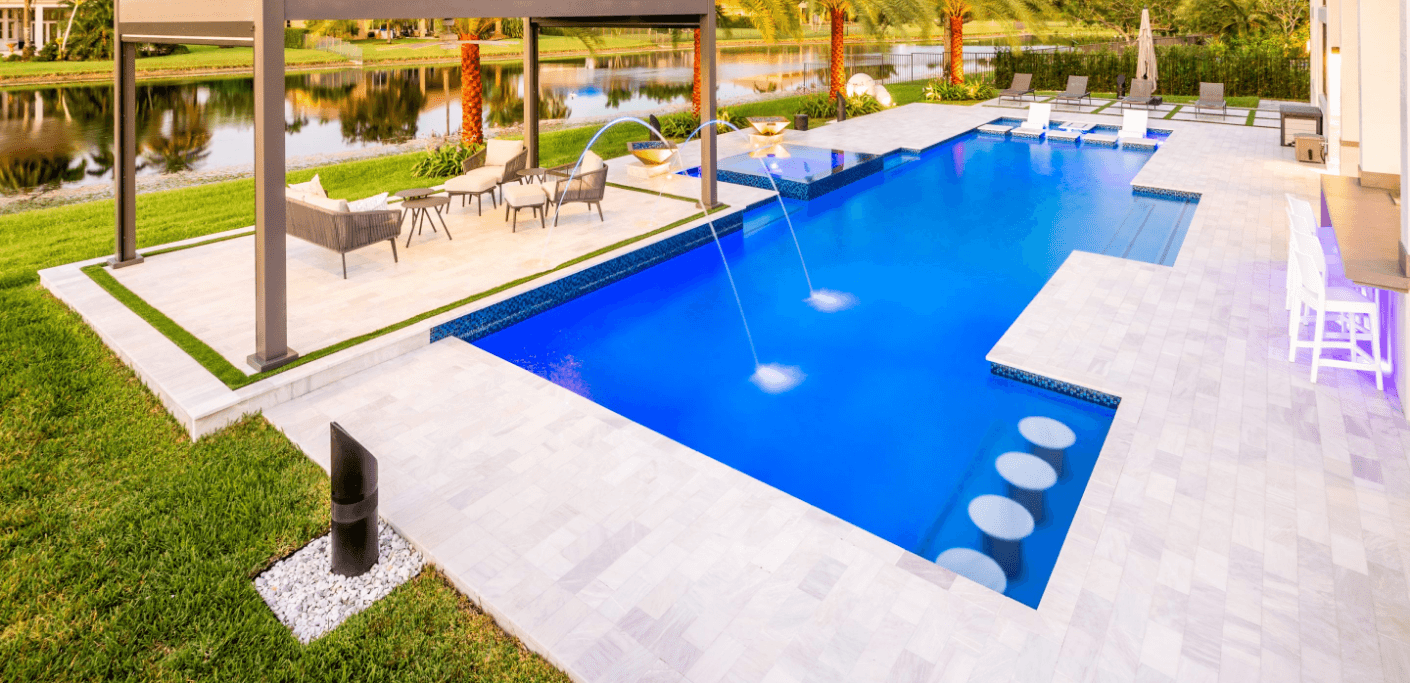
What is an infinity edge pool?
In an infinity edge pool, one or more sides of the pool are built so water flows over the top of the wall and out of sight. From the right angle, the water appears to continue into the landscape beyond. The terms vanishing edge and negative edge describe the same idea.
How the design works
The finished edge wall is built slightly lower than the water level, so water spills over it in a thin, even sheet. A catch basin, or trough, collects the overflow on the outside of the wall. Pumps return that water to the pool, so the system recirculates continuously.
That recirculating loop is what separates this design from a conventional pool: the edge, the catch basin and the return plumbing all have to be built precisely, because a small error in height or level shows up as an uneven sheet of water.
Where a vanishing edge makes sense
Level lots can still carry the effect, usually by raising part of the pool above grade with a visible wall. We assess the property during the site visit and tell you plainly whether the design suits it.
- Sloped or terraced lots, where the drop beyond the edge makes the effect most dramatic
- Properties with a view of a lake, valley, tree line or skyline
- Designs that call for a clean, modern look with a spillway or wall on one side
What to plan for
- Structure: the edge wall and catch basin add engineering and construction to the shell.
- Plumbing and equipment: the return system and water-level control need careful design.
- Sight lines: the view from the pool and from the house toward the pool should be planned together.
- Finishes: stone or tile on the visible edge face are part of the design and the budget.
- Maintenance: the catch basin and water level need regular attention, so ask how the system will be maintained.
Cost
Vanishing-edge designs generally cost more than a comparable conventional pool because of the added structure and plumbing. Your proposal itemizes this for your property.